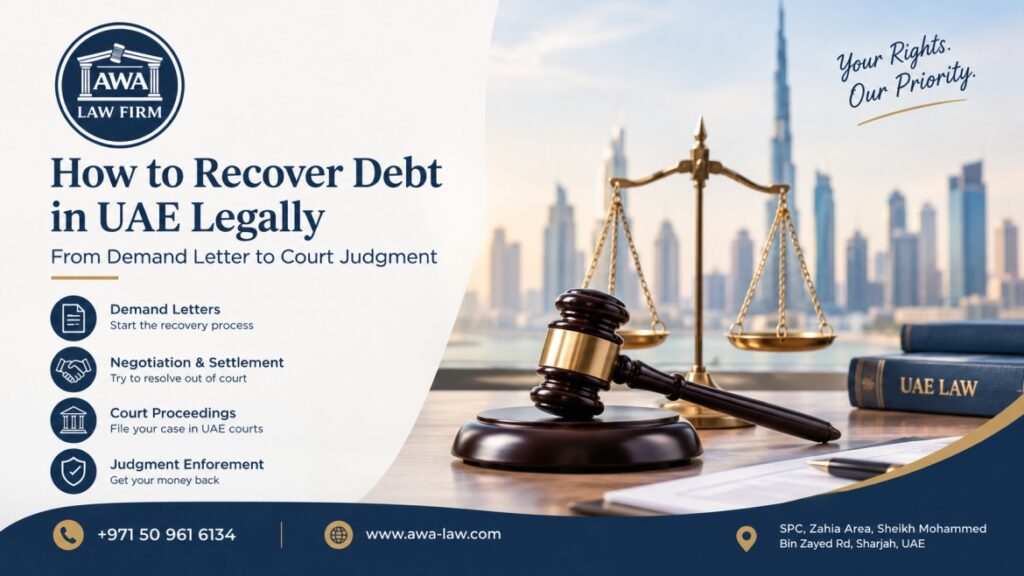
Recovering money from a person or company that has failed to pay can be stressful, especially when informal reminders and negotiations do not work. In the UAE, creditors have several legal options for recovering unpaid debts, including formal demand letters, settlement negotiations, court proceedings, precautionary measures, and judgment enforcement.
If you are wondering how to recover debt in UAE legally, the right approach depends on the type of debt, the supporting documents available, the parties involved, and the applicable jurisdiction.
For businesses, unpaid invoices, outstanding commercial payments, and delayed contractual obligations can affect cash flow and operations. Taking timely legal action can help protect your interests and establish a clear path toward recovery.
Step 1: Review Your Debt Documents and Evidence
Before starting a legal debt recovery process, collect all documents that establish the existence and amount of the debt.
Depending on your situation, useful evidence may include:
- Signed contracts or agreements
- Unpaid invoices
- Purchase orders
- Account statements
- Payment receipts
- Bank transaction records
- Delivery documents
- Emails and written communications
- WhatsApp messages or other relevant correspondence
- Written acknowledgements of the outstanding amount
For an unpaid invoice in the UAE, it is particularly important to establish that the goods or services were actually provided and that the payment became due under the agreed terms.
Organizing your evidence before taking action can make the debt recovery process more efficient and help your legal representative understand the claim.
Step 2: Send a Formal Legal Demand Letter
One of the first practical steps in debt collection in the UAE may be sending a formal demand for payment.
A properly prepared demand letter should generally identify the creditor and debtor, explain the basis of the debt, specify the outstanding amount, and provide a clear deadline for payment.
The letter can also explain the potential legal consequences of continued non-payment, subject to the applicable law and circumstances.
A demand letter sometimes resolves a dispute before court proceedings become necessary. It also creates a documented record showing that the debtor was informed about the outstanding obligation.
For this reason, creditors should avoid relying only on informal messages such as “please pay soon.” A formal and properly documented approach can provide greater clarity.
Step 3: Try Negotiation and an Out-of-Court Settlement
Not every debt dispute needs to end in litigation.
In some cases, the debtor may be willing to pay the outstanding amount but may require additional time. A creditor may therefore consider negotiating a structured repayment plan or settlement.
Possible arrangements may include:
- Full payment by an agreed deadline
- Instalment payments
- A written settlement agreement
- Partial payment followed by scheduled payments
- Payment against specific contractual milestones
Any settlement should be documented clearly. The agreement should identify the amount being paid, payment dates, consequences of default, and other important terms.
If negotiations fail or the debtor continues to avoid payment, the creditor may need to consider formal legal proceedings.
Step 4: File a Debt Recovery Case in UAE
When voluntary recovery efforts do not succeed, filing a legal claim may become necessary.
The appropriate court and procedure depend on factors such as the parties, contract, location, type of transaction, jurisdiction clause, and nature of the dispute.
For a debt recovery case in Dubai, the relevant Dubai court procedure may apply where the dispute falls within its jurisdiction.
A creditor may need to provide supporting documentation demonstrating:
- The legal relationship between the parties
- The existence of the financial obligation
- The amount claimed
- That payment became due
- That the debtor failed to pay
- Relevant communications and previous recovery efforts
The court process can involve filing the claim, notifying the defendant, submitting evidence, attending hearings where required, and responding to the other party’s arguments.
Because procedural requirements can vary, obtaining legal guidance before filing can help a creditor understand the appropriate route for the specific dispute.
DIFC Courts and Commercial Debt Disputes
Some commercial disputes involving international businesses may fall within the jurisdiction of the DIFC Courts, depending on the applicable agreements and jurisdictional requirements.
DIFC jurisdiction should not simply be assumed because a business operates in Dubai. The contract, parties, applicable laws, and jurisdiction provisions need to be reviewed carefully.
For cross-border or complex commercial debt disputes, professional legal advice can help determine which forum may be appropriate.
Step 5: Consider Precautionary Attachment or Freezing Measures
In certain circumstances, a creditor may be concerned that a debtor could dispose of assets or otherwise make recovery more difficult.
Depending on the circumstances and applicable legal requirements, a creditor may seek precautionary measures such as an attachment order.
These measures are different from ordinary enforcement after a final judgment. A court will consider the relevant legal requirements and evidence before granting any requested relief.
If you believe a debtor may be transferring or hiding assets, it is important to discuss the situation with a qualified UAE lawyer promptly rather than attempting to take action independently.
Step 6: Enforce the Court Judgment
Winning a debt recovery case does not necessarily mean that the money automatically appears in the creditor’s bank account.
Where a judgment is enforceable, the creditor may need to initiate appropriate enforcement proceedings.
Depending on the circumstances and applicable law, enforcement mechanisms may involve measures concerning:
- Bank accounts
- Certain assets
- Receivables
- Property or other attachable assets
- Asset seizure and sale through applicable procedures
The exact enforcement options depend on the judgment, the debtor’s assets, and the applicable UAE enforcement rules.
This stage is particularly important because successful court judgment enforcement in Dubai can require careful procedural follow-up.
Recovering Debt from a UAE Company
Recovering money from a company can involve additional considerations.
If a company has stopped operating, entered liquidation, or changed its business status, the creditor should first establish the company’s current legal position and review the underlying agreement.
The legal structure of the business, contractual obligations, available assets, and applicable insolvency or liquidation procedures may affect the recovery process.
A creditor should also avoid assuming that company debts automatically become the personal debts of shareholders or directors. Personal liability depends on the applicable law and specific circumstances.
International Debt Recovery in the UAE
Some UAE businesses deal with customers, suppliers, or companies located outside the country. This can make debt recovery more complicated because more than one jurisdiction may be involved.
The contract should be reviewed for provisions dealing with:
- Jurisdiction
- Governing law
- Arbitration
- Payment obligations
- Dispute resolution
Where a foreign judgment or order is involved, additional requirements may apply before it can be recognized or enforced in another jurisdiction.
For international commercial debt, early legal advice can help identify the appropriate recovery strategy.
How AWA Law Firm Can Help with Debt Recovery
Debt recovery can involve more than simply sending repeated payment reminders. A creditor may need assistance reviewing documents, preparing a formal demand, negotiating with the debtor, initiating legal proceedings, or pursuing enforcement.
AWA Law Firm provides legal assistance for debt collection and related disputes in the UAE. Depending on the circumstances, legal support may include reviewing the debt documentation, advising on recovery options, assisting with negotiations, and guiding clients through court or enforcement procedures.
If you are dealing with an unpaid invoice in the UAE, commercial debt, an outstanding payment, or another financial claim, getting advice early can help you understand the available legal options.
AWA Law Firm is located at:
SPC, Zahia Area, Sheikh Mohammed Bin Zayed Rd, Sharjah, United Arab Emirates
Phone: +971 50 961 6134
Frequently Asked Questions About Debt Recovery in the UAE
How long does debt recovery take in UAE courts?
There is no single timeline for every case. The duration can depend on the complexity of the dispute, documents, service of notices, hearings, appeals, and enforcement requirements.
Can I recover debt without going to court?
Yes, depending on the circumstances. Negotiation, settlement agreements, and voluntary repayment can sometimes resolve a debt without litigation.
Can I recover an unpaid invoice in Dubai?
An unpaid invoice may form part of a debt claim when supported by appropriate evidence showing the underlying transaction, payment obligation, and outstanding amount. The applicable legal procedure depends on the circumstances.
Can I recover debt from a UAE free zone company?
Potentially, but the appropriate procedure depends on the company’s legal structure, jurisdiction, contractual arrangements, and the nature of the claim.
Can a debtor’s assets be attached?
Certain precautionary or enforcement measures may be available when the applicable legal requirements are satisfied. A court or competent authority will determine whether the requested measure can be granted.
Conclusion
Knowing how to recover debt in UAE legally can help creditors avoid unnecessary delays and choose an appropriate recovery strategy. The process may begin with reviewing evidence and sending a formal demand letter, followed by negotiation, court proceedings, and, where applicable, judgment enforcement.
Whether you are trying to recover a personal debt, unpaid invoice, or commercial payment, the correct legal route depends on the facts of your case.
If you need assistance with debt recovery in the UAE or debt collection in Dubai, AWA Law Firm can help you understand the available legal options and the appropriate next steps.
AWA Law Firm
SPC, Zahia Area, Sheikh Mohammed Bin Zayed Rd, Sharjah, United Arab Emirates
Phone: +971 50 961 6134