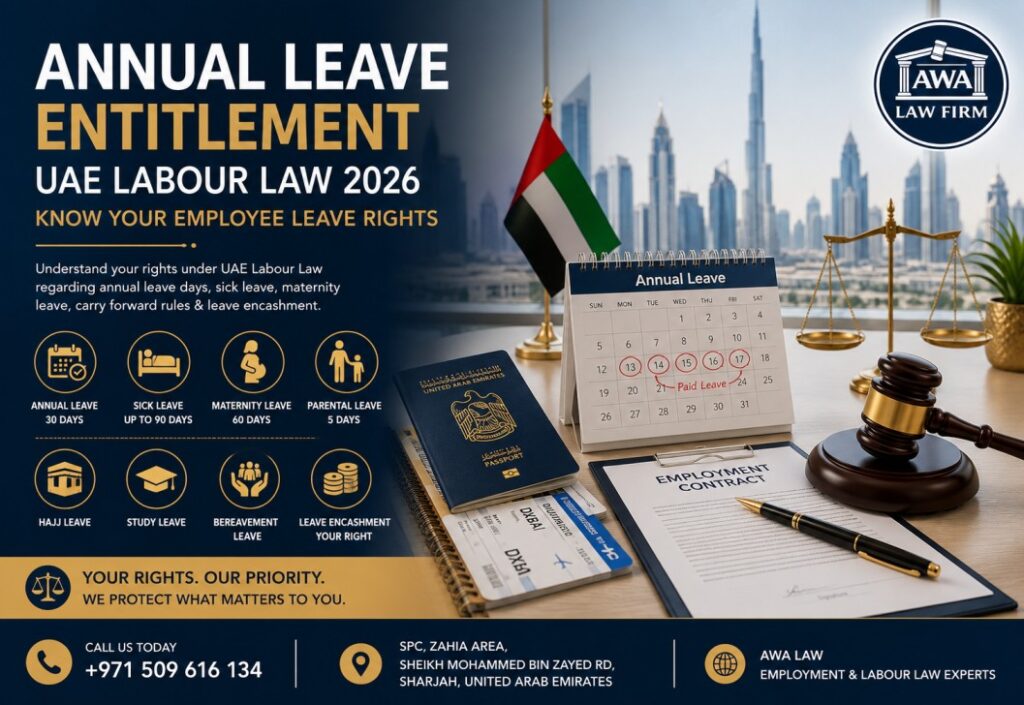
Employee leave rights are protected under UAE Labour Law, ensuring workers receive paid annual leave, sick leave, maternity leave, and other statutory leave benefits. Understanding your Annual Leave Entitlement UAE Labour Law is essential whether you are an employee planning your vacation or an employer managing workforce compliance.
Many employees ask questions like the following:
- How many UAE annual leave days am I entitled to?
- Can my employer refuse annual leave?
- What happens to unused leave?
- Can I receive leave encashment in the UAE instead of taking leave?
This guide explains everything you need to know about Annual Leave Entitlement UAE Labour Law in simple language, based on the latest UAE Labour Law provisions.
Table of Contents
- Annual Leave Days Under UAE Labour Law 2026
- Other Types of Leave You’re Entitled to in UAE
- Can Employer Carry Forward or Encash Leave in UAE?
- Leave During Notice Period
- What If Employer Refuses Annual Leave?
- Common Mistakes Employees Should Avoid
- When to Consult Labour Lawyers
- Frequently Asked Questions
Annual Leave Days Under UAE Labour Law 2026
The UAE Labour Law provides paid annual leave based on an employee’s length of continuous service.
Your leave entitlement depends on how long you have worked with the employer.
Less Than 6 Months Service — No Annual Leave
Employees who have completed less than six months of continuous employment are generally not entitled to paid annual leave.
However, this does not affect other statutory rights, such as:
- Weekly rest days
- Public holidays
- Emergency leave where applicable
Some employers voluntarily provide additional leave through employment contracts or company policies.
6 Months to 1 Year — Proportional Leave
Employees who have completed more than six months but less than one year receive annual leave on a proportional basis.
The entitlement is calculated as follows:
2 calendar days of leave per month of service.
For example:
If you have worked for 8 months:
- 2 days × 8 months
- Total = 16 calendar days
This proportional calculation applies until completing one full year of employment.
After completing one year of continuous service, employees are entitled to 30 calendar days of paid annual leave each year.
Once an employee completes one year of continuous service, they become entitled to:
30 calendar days of paid annual leave every year.
This is one of the most important employee benefits under annual leave entitlement under UAE labour law.
Your employer must pay your normal salary during annual leave.
The leave should normally be scheduled by agreement between employer and employee while considering business requirements.
Many employees searching for leave entitlement in Dubai have the same legal rights under federal UAE labour law.
Other Types of Leave You’re Entitled to in UAE
Annual leave is only one part of employee leave rights.
The Labour Law also provides several other forms of protected leave.
Sick Leave — 90 Days
Employees are also entitled to sick leave and UAE law protections after completing the qualifying period.
An employee may receive up to 90 days of sick leave per year, subject to medical certification.
The payment structure generally includes:
- First 15 days – Full Pay
- Next 30 days – Half Pay
- Remaining 45 days – Unpaid
Employees should notify their employer promptly and provide approved medical documentation where required.
Maternity Leave — 60 Days
Female employees receive 60 days of maternity leave under UAE labour law.
The entitlement consists of:
- 45 days with full pay
- 15 days with half pay
Depending on medical circumstances and the child’s health, additional leave may also be available under the law.
Many online searches still use the phrase maternity leave UAE 2025, but employees should always rely on the latest legal provisions currently in force.
Parental Leave for Fathers — 5 Days
Working parents are also protected.
Eligible fathers receive:
5 working days of paid parental leave
This leave can usually be taken within the legally prescribed period following the child’s birth.
The purpose is to allow fathers to support their families during the early stages after childbirth.
Hajj Leave, Study Leave & Bereavement Leave
The UAE Labour Law also recognises several additional leave categories, including the following:
Hajj Leave
Eligible Muslim employees may receive Hajj leave according to legal requirements and employer policies.
Study Leave
Employees enrolled in approved educational programmes may qualify for study leave if legal conditions are satisfied.
Bereavement Leave
Employees are entitled to compassionate leave following the death of certain close family members.
These leave rights help ensure employees can balance personal responsibilities with work obligations.
Can an Employer Carry Forward or Encash Leave in UAE?
One of the most common questions concerns carry-forward leave UAE rules.
In many situations:
- Annual leave should be taken during the relevant leave year.
- Employers may allow employees to carry unused leave forward depending on company policy and legal compliance.
- Certain employment contracts may specify carry-forward limits.
Another important issue is leave encashment in the UAE.
If employment ends and an employee has accumulated unused annual leave, they are generally entitled to receive payment for those unused leave days.
The amount is calculated based on the employee’s wage, as required by UAE Labour Law.
Leave During the Notice Period — Are You Entitled?
Employees often wonder whether annual leave can be taken after resignation.
The answer depends on several factors.
During the notice period:
- The employer may approve annual leave.
- The employer may instead require the employee to work during notice.
- Unused leave is often settled financially upon termination.
Every employment situation is different, making legal advice valuable where disputes arise.
If your employment has been unfairly terminated while leave payments remain outstanding, you may also find our guide on wrongful termination in the UAE helpful.
What If an Employer Refuses to Give Annual Leave?
Although employers have the right to organise leave schedules, they cannot permanently deny statutory leave rights.
If your employer refuses annual leave without lawful justification, you should:
- Discuss the matter with HR.
- Keep written communication records.
- Review your employment contract.
- Request clarification in writing.
- Seek legal advice if the issue remains unresolved.
Where necessary, employees may file a complaint through the appropriate labour dispute resolution channels.
Legal guidance can help determine whether the employer has violated UAE labour law.
Common Mistakes Employees Should Avoid
Many employment disputes arise because employees misunderstand their legal rights.
Avoid these common mistakes:
- Assuming annual leave expires automatically.
- Not keeping records of approved leave.
- Resigning without checking unused leave balances.
- Accepting unpaid leave without understanding your legal entitlement.
- Ignoring payroll calculations for leave encashment.
Proper documentation is essential if a disagreement later arises.
When Should You Contact Labour Lawyers?
Professional legal advice may be beneficial if:
- Your employer refuses annual leave.
- Leave salary has not been paid.
- You were dismissed before taking accrued leave.
- Your leave entitlement Dubai calculation appears incorrect.
- You have not received leave encashment in the UAE after resignation.
- Your employer has withheld final settlement payments.
If your case also involves unpaid wages, you may find our article about unpaid salary in Dubai useful.
Experienced labour lawyers in Dubai can assess your employment contract, calculate statutory entitlements, negotiate with employers, and represent you during labour disputes.
Why Choose AWA Law?
At AWA Law, we assist employees and employers with UAE employment law matters, including:
- Annual leave disputes
- Employment contracts
- Wrongful termination
- End-of-service benefits
- Salary disputes
- Labour court representation
- Employment compliance advice
Whether you are protecting your rights as an employee or ensuring compliance as an employer, our legal team provides practical guidance based on current UAE labour law.
Office Address:
SPC, Zahia Area, Sheikh Mohammed Bin Zayed Rd, Sharjah, United Arab Emirates
Call: +971509616134
Frequently Asked Questions
Does my employer have to pay me for unused leave in UAE?
Yes. If you have accrued annual leave that remains unused when your employment ends, you are generally entitled to payment for those leave days in accordance with UAE Labour Law.
How many UAE annual leave days do employees receive?
Employees who complete one year of continuous service are generally entitled to 30 calendar days of paid annual leave each year.
Can my employer refuse annual leave?
Employers may determine the timing of annual leave based on business needs, but they cannot permanently deny your statutory leave entitlement.
Can annual leave be carried forward?
Yes, carrying forward leave in the UAE may be permitted depending on company policy, employment agreements, and applicable legal requirements.
Is leave encashment mandatory after resignation?
Employees are generally entitled to receive payment for accrued but unused annual leave upon termination of employment, subject to UAE Labour Law.
Do employees receive sick leave separately from annual leave?
Yes. Sick leave UAE law provides a separate entitlement and does not reduce your annual leave balance when statutory conditions are met.
Final Thoughts
Understanding your annual leave entitlement UAE labour law helps protect your workplace rights and ensures you receive the benefits guaranteed under UAE legislation. Whether your concern involves UAE annual leave days, carry-forward leave in the UAE, leave encashment in the UAE, or disputes over leave entitlement in Dubai, knowing the law is the first step towards resolving the issue.
If your employer has refused annual leave, withheld leave salary, or failed to pay your final settlement, seek professional legal advice without delay.
AWA Law is here to help you understand your rights and pursue the appropriate legal solution.
Office: SPC, Zahia Area, Sheikh Mohammed Bin Zayed Rd, Sharjah, United Arab Emirates
Phone: +971509616134